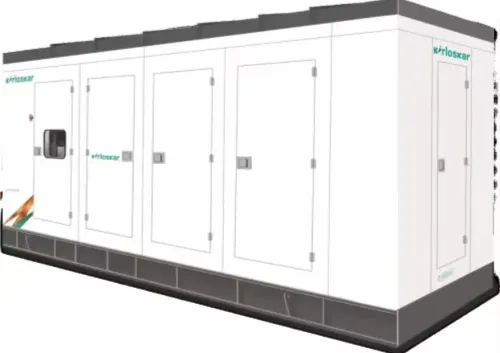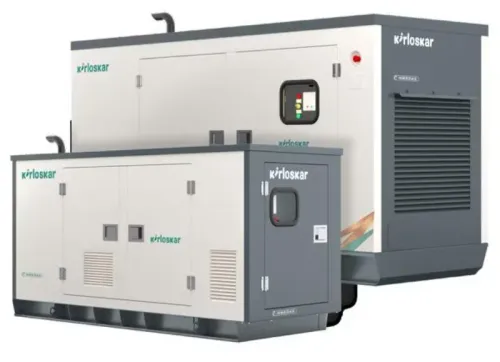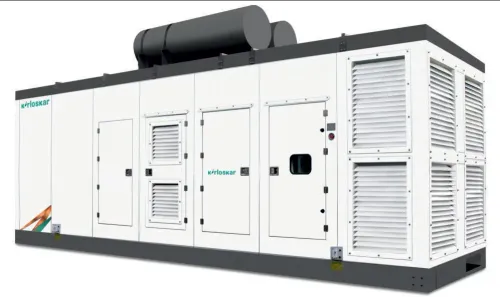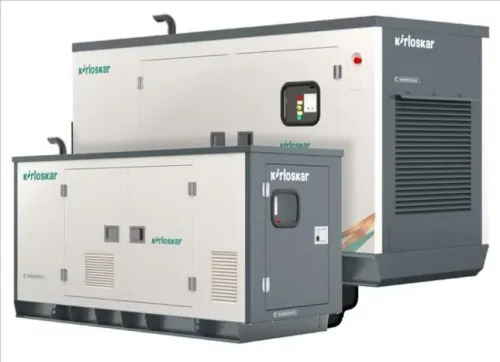
A generator that matches only the largest nameplate can still fail when a pump, compressor, hoist or welding set starts under load. You will be able to calculate the site’s real running demand, test whether a 45 kVA class is adequate, and specify the electrical, weather-protection and service requirements that keep temporary power operating through Bangalore’s monsoon.
Key takeaways
- Size the generator from simultaneous running and starting loads.
- A 45 kVA set works only when the measured site demand leaves starting headroom.
- Specify AVR, voltage, frequency, earthing, overload protection and phase balance.
- Use a raised, drained, weatherproof installation with protected cable connections.
How do you calculate the generator size from actual site loads?
A usable generator size comes from the loads that run together, not from the largest nameplate on site. Build this schedule before comparing models for a generator for construction site in Bangalore:
- Concrete mixer, dewatering pump, welding machine, tower hoist, compressor, grinder, lighting circuit and site-office appliance
- Rated volts, amps, kW or kVA, phase and starting method for each item
Add only equipment expected to operate simultaneously. That total is the coincident running load; do not add every nameplate unless every machine runs together.
| Calculation | Example | Result |
|---|---|---|
| Real power from apparent power | 45 kVA × 0.8 power factor | 36 kW |
| Motor starting current | Direct-on-line motor at 5–7 times full-load current | Separate starting demand |
| Site running total | All simultaneous loads in kW | Compare with prime rating |
Calculate motor-starting demand separately. A direct-on-line induction motor can draw five to seven times its full-load current, causing voltage and frequency dips even when running load fits. Record which motors start together, then use sequential starts, unloaded starts, soft starters or variable-frequency drives.
Keep a realistic allowance for equipment arriving later, not an unconfirmed wish list. Compare expected minimum load too: a large diesel set running lightly can wet-stack and carbon-foul. Finally, check Bangalore’s roughly 900-metre elevation, maximum ambient temperature, radiator margin and enclosure airflow against the engine and alternator data sheet before accepting the nameplate rating.
Is a 45 kVA generator enough for a Bangalore construction site?
Treat a 45 kVA generator for site work in Bangalore as a calculation result to verify, not a product assumption. At 0.8 power factor, 45 kVA equals 36 kW of continuous real power. Keep simultaneous running demand comfortably below 36 kW so a motor start does not cause an unacceptable voltage dip.
| Option | Capacity | Decision |
|---|---|---|
| 45 kVA requirement | 36 kW at 0.8 power factor | Verify with measured running load and starting demand |
| 30 kVA set | 24 kW at 0.8 power factor | Reject if coincident load or a starting event exceeds its prime rating |
| 100 kVA set | 80 kW at 0.8 power factor | Use for expansion or unavoidable simultaneous starting |
For example, a 7.5 kW dewatering pump, 5 kW mixer, 4 kW compressor, 6 kW welding set, 2 kW hoist controls, 3 kW of grinders and tools, and 2 kW of lighting and office loads total 29.5 kW when operating together. That leaves limited headroom for motor starting, welding fluctuation and future additions.
Start the pump, mixer and compressor one at a time, then confirm the largest motor’s starting current with the supplier. The catalogue has no 45 kVA product, so compare the calculated requirement with the available 30 kVA and 100 kVA options; do not treat 30 kVA as close enough.
Choose the smaller set only after a measured load test proves the margin. Choose the larger set when expansion or simultaneous starting is unavoidable, while planning fuel use, load scheduling and a minimum-load strategy.
What electrical specification prevents voltage dips and unsafe site power?
Specify the generator’s supply and distribution system before delivery, not after voltage dips expose a mismatch. Confirm whether you need 400/230 V, three-phase, 50 Hz output or single-phase power for small tools. Tower hoists, large pumps, compressors and many welding sets require compatible three-phase output.
Balance single-phase lights, office sockets and battery chargers across all three phases. One overloaded phase can trip breakers or cause low voltage while the generator appears lightly loaded overall.
Put these points into the purchase checklist:
- State the required power factor, alternator regulation, AVR performance, waveform quality and permissible harmonic loading for electronic welders, computers, chargers and variable-speed drives.
- Ask whether direct-on-line motor inrush will cause a voltage dip. Confirm whether soft starters, VFDs, unloaded starting or sequential starts are needed; motors can draw five to seven times full-load current.
- Size every cable for both current capacity and allowable voltage drop. Cover cables across vehicle routes with ramps or suitable mechanical covers.
- Use a weather-resistant distribution board, correctly rated breakers and residual-current protection where the installation requires it.
- Coordinate earthing, neutral bonding and the manual changeover or ATS so utility back-feed is impossible.
- Include these details when comparing a diesel genset for contractors in Bangalore. A generator for construction site in Bangalore cannot correct an overloaded phase, loose termination or undersized cable.
How should you protect the genset during Bangalore monsoon work?
Place the genset on a rigid, level plinth above the site’s likely mud and standing-water level. Grade drainage away from the fuel tank and electrical panel, and leave clear space around the radiator intake and hot-air discharge.
Do not wrap a running genset in tarpaulin. Trapped exhaust heat recirculates and can overheat the engine. Use an open-sided rain shelter with a roof, splash protection and enough airflow. An alternator commonly marked IP23 is not waterproof: driving rain, hose water and flooding still require protection.
Seal cable entries, keep the control panel closed, inspect for condensation and prevent alternator splash-back.
Use this checklist for a diesel generator for monsoon construction sites in Bangalore:
- Fit an exhaust rain cap without exceeding the engine maker’s back-pressure limit. Route fumes away from workers, temporary offices and air intakes because wind can push exhaust into semi-enclosed areas.
- Cover the fuel fill point. Use a sealed, labelled fuel system; drain the water separator as instructed; and inspect fuel for water or microbial sludge.
- Route cables away from puddles and traffic. Use suitable weather-resistant connectors, maintain earthing and provide lightning protection for the temporary installation.
- Check the engine and alternator data sheet for Bangalore’s roughly 900-metre elevation, maximum ambient temperature, altitude derating and required radiator margin.
- Confirm that the shelter’s drainage cannot flood the plinth, and never use a canopy that blocks radiator airflow or exhaust discharge.
What should you put in the quotation and verify before commissioning?
Put the duty in writing so every supplier prices the same machine, installation and test. State prime or standby rating, ISO 8528 rating category, permitted annual operating hours, overload allowance, 400/230 V three-phase output, 50 Hz frequency and power factor.
| Rating | Use | Quotation check |
|---|---|---|
| Prime power | Variable-hour construction supply | State permitted hours, load profile and overload allowance |
| Standby power | Emergency outage backup | Do not use routinely without written confirmation of hours and loading |
Require the quotation to identify:
- Exact engine-generator model, engine model, emission stage, manufacturing-date applicability and CPCB IV+ approval or conformity documents; do not accept a generic compliance claim.
- Noise limit at a named measurement distance, enclosure, roof and rain-splash protection, fuel-tank autonomy, Bangalore altitude and maximum ambient-temperature conditions.
- Cable-termination method, manual changeover or ATS arrangement, and no-back-feed protection.
At commissioning, test actual site loads: motor starts, welding loads, phase balance, voltage dip, frequency recovery, earth continuity, emergency stop and no-back-feed operation. Record results.
Also obtain service response time, authorised commissioning, filter and belt availability, first-service timing, fault-code support, battery-charging checks and emergency-shutdown procedures. Metro Power Corporation is one Bangalore supplier to include when comparing authorised Kirloskar or KOEL commissioning and monsoon support, but check its written duty and scope against every quotation.
Related products
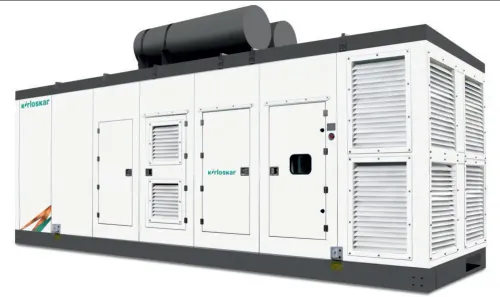
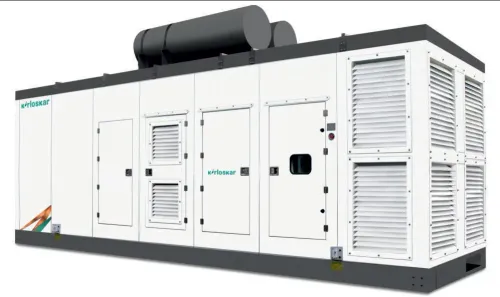
 | CPCB IV+ 7.5KVA TO 20KVA • Prime rating and Stand-by rating • State of the art Genset Controller • No replacement to displacement • Peace-of-mind Ownership • Best Fluid... View product → |
 | CPCB IV+ 7.5KVA TO 20KVA • Prime rating and Stand-by rating • State of the art Genset Controller • No replacement to displacement • Peace-of-mind Ownership • Best Fluid... View product → |
Frequently asked questions
How do you calculate the generator size from actual site loads?
List every appliance, its running kW or kVA, starting current, operating hours and phase. Add the loads that operate together, account for motor starting demand, then retain headroom for temporary changes rather than sizing from the largest nameplate.
Is a 45 kVA generator enough for a Bangalore construction site?
It is enough only when the simultaneous running demand and motor-starting requirement stay within the set’s rated output. Check welders, pumps, compressors, hoists, lighting and chargers together; do not decide from site area or one machine rating.
What electrical specification prevents voltage dips and unsafe site power?
Request an automatic voltage regulator, stable 50 Hz output, the required single- or three-phase voltage, overload and short-circuit protection, correct earthing, and a site distribution board with residual-current protection. Confirm phase loading before commissioning.
How should you protect the genset during Bangalore monsoon work?
Install it on a raised, level plinth under a ventilated weatherproof canopy, with drainage around the base. Keep exhaust outlets clear, elevate cable joints, use sealed distribution equipment, and never connect or refuel through standing water.
What should you put in the quotation and verify before commissioning?
Record rated kVA and kW, voltage, frequency, phase arrangement, fuel tank capacity, canopy type, protections, delivery scope, cables, earthing, testing, service response and warranty. Before handover, test load sharing, voltage, frequency, emergency stop, insulation, earthing and every connected circuit.
Related products
 | CPCB IV+ 320kVA to 750kVA • Prime rating and Stand-by rating • State of the art Genset Controller • No replacement to displacement • Peace-of-mind Ownership • Best Fluid... View product → |
 | CPCB IV+ 82.5KVA TO 160KVA • Prime rating and Stand-by rating • State of the art Genset Controller • No replacement to displacement • Peace-of-mind Ownership • Best Fluid... View product → |
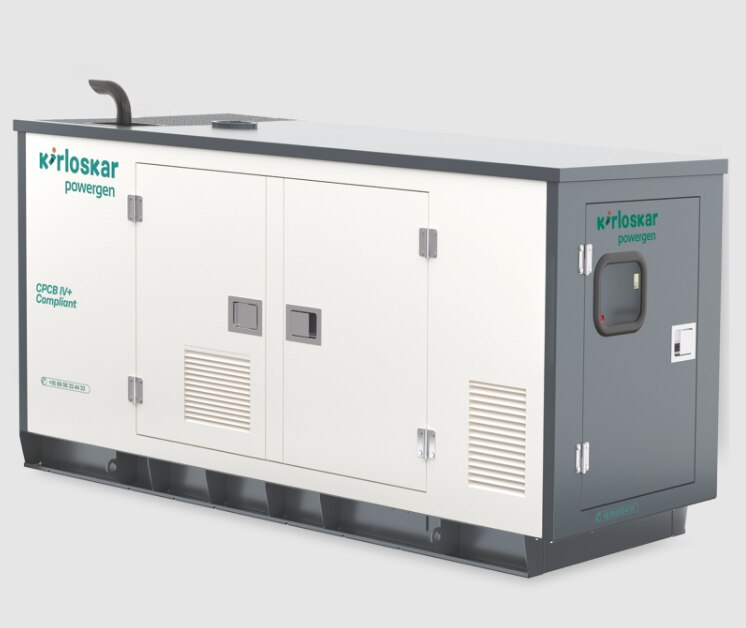
 | CPCB IV+ 25KVA TO 58.5KVA • Prime rating and Stand-by rating • State of the art Genset Controller • No replacement to displacement • Peace-of-mind Ownership • Best Fluid... View product → |
 | CPCB IV+ 7.5KVA TO 20KVA • Prime rating and Stand-by rating • State of the art Genset Controller • No replacement to displacement • Peace-of-mind Ownership • Best Fluid... View product → |
Keywords