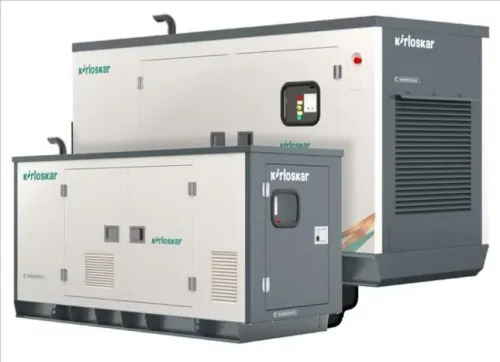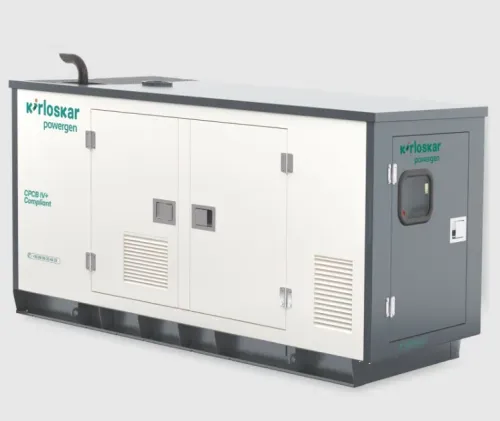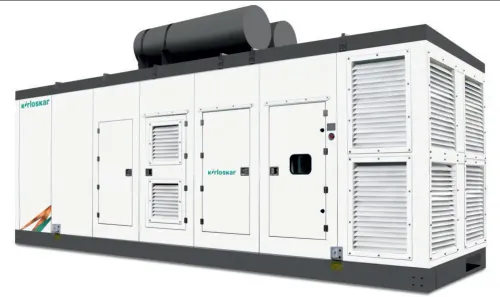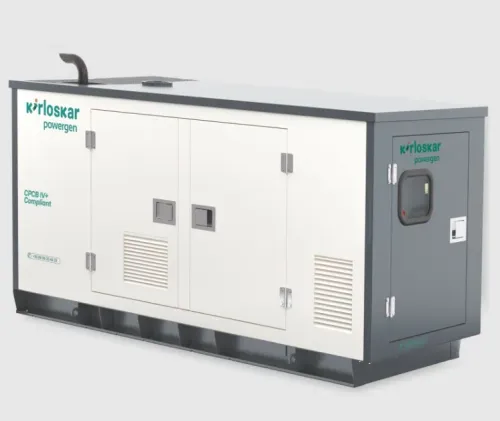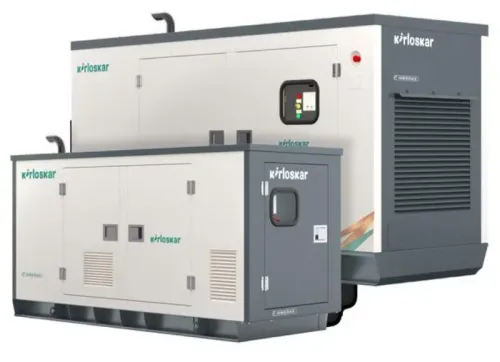
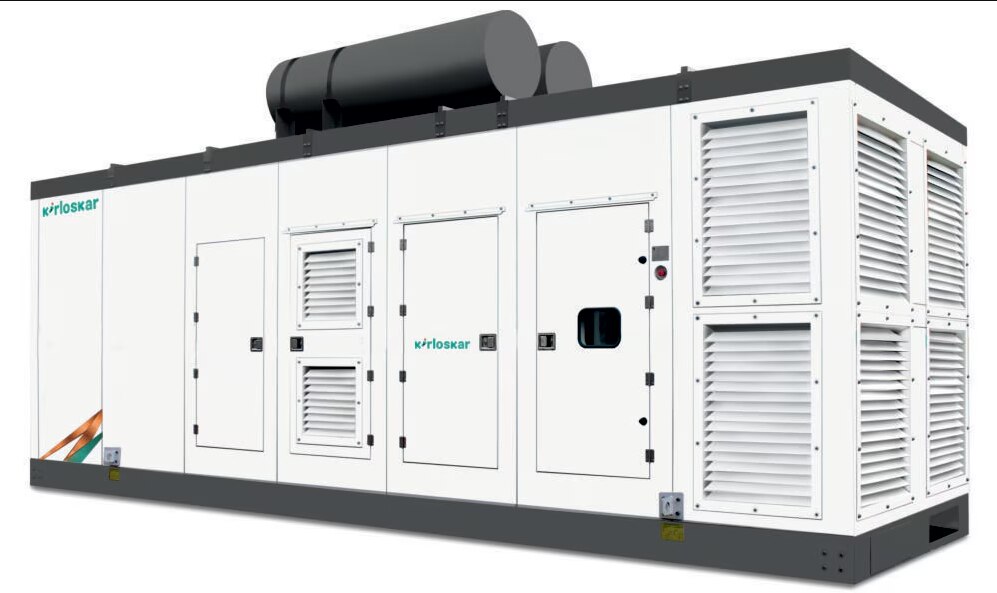
The choice between these two generator sizes depends on more than the connected load: motor-starting demand, power factor, duty cycle, site conditions and future expansion can change the answer. By the end, you will be able to calculate a realistic load, distinguish prime from standby service and request comparable quotations for a Bangalore installation.
Key takeaways
- A 25 kVA set provides about 20 kW at 0.8 power factor.
- A 40 kVA set provides about 32 kW at 0.8 power factor.
- Choose prime power for regular operation, standby for emergency backup.
- Include motor starting current and site derating before selecting generator size.
What do 25 kVA and 40 kVA actually deliver?
At 415 V and 0.8 power factor, a 25 kVA set delivers about 20 kW of real power, while a 40 kVA set delivers about 32 kW. The nameplate is not a promise that every appliance can use that output: power factor, starting demand and site derating reduce practical headroom.
| Set | Approximate real power at 0.8 PF | Full-load line current |
|---|---|---|
| 25 kVA | 20 kW | 34.8 A |
| 40 kVA | 32 kW | 55.6 A |
A 40 kVA unit gives 12 kW more running capacity and roughly 60% more kVA headroom than a 25 kVA unit. That margin helps absorb lighting, servers, pumps and future equipment, but it does not automatically handle a large direct-on-line motor.
One compressor or several motors starting together can still cause voltage and frequency dips if alternator transient data is inadequate.
For a prime and standby generator comparison, match the rating to the duty, not only the number. Standby rating covers emergency outages; prime rating covers variable-load operation for unlimited hours under ISO 8528-1 conditions, including its 10% overload allowance for one hour in 12 hours.
A 25 kVA standby set is not an equivalent replacement for a 25 kVA prime set at a remote site.
In Bangalore, check the manufacturer’s derating table at about 920 m elevation and the expected ambient temperature. Compare CPCB IV+ generator sizes using the same manufacturer’s datasheet, including fuel consumption at your actual load; a larger engine running lightly loaded can waste fuel.
Should you choose prime power or standby power?
Choose standby power if the generator runs only during utility failures and returns to rest when grid supply is restored. Choose prime power if it will supply a site for long, recurring periods with changing demand, such as a construction project, telecom installation or remote facility.
| Rating basis | What it permits | Suitable operating pattern |
|---|---|---|
| Emergency standby power | Limited-duration outage support | Infrequent failures, with the utility as the normal source |
| Prime power | Variable-load operation for unlimited hours under ISO 8528-1 conditions | Daily or extended operation where the generator is the main source |
| Prime-power overload condition | Up to 10% overload for one hour in any 12-hour period | A defined ISO condition, not permission to run routinely overloaded |
Do not compare only the number on the nameplate. The same engine-alternator package can have different standby and prime ratings, so compare both figures on the same manufacturer’s datasheet. A 25 kVA standby generator in Bangalore is not an equivalent substitute for a 25 kVA prime generator running a facility throughout the day.
For a prime application, document annual running hours, average load factor, maximum step load and maintenance intervals before choosing the set.
For standby use, check the largest motor start, compressor sequence, UPS input and allowable voltage dip; a 40 kVA standby generator in Bangalore adds starting margin, but it will still struggle with a large direct-on-line motor or simultaneous compressor starts if transient-performance data is inadequate.
Avoid oversizing purely for comfort: prolonged low-load running can increase wet-stacking risk. Follow the manufacturer’s minimum-load guidance and plan periodic load-bank testing.
How do you size the set from real loads and starting demand?
Choosing a 25 kVA or 40 kVA diesel generator for prime and standby in Bangalore starts with measured demand, not the total of equipment nameplates. Separate essential loads, calculate their running kW and kVA, then test the largest simultaneous starting event.
1. Record each load’s rated kW, power factor, phase, starting method and duty cycle. Mark motors, compressors, transformers, UPS systems, lifts and air-conditioners separately.
2. Apply realistic diversity: exclude equipment that will not run together, but keep every load needed during an outage. Add 15–20% capacity for planned expansion only after calculating the actual operating total.
3. Model the worst start. Include a DOL motor’s starting kVA, several compressors starting together, transformer energisation, UPS rectifier behaviour and nonlinear loads. Check the supplier’s voltage and frequency dip against the equipment limits; steady-state kVA alone cannot prove that a motor will start.
4. Compare the result with the set’s rating at your power factor. At 415 V and 0.8 power factor, 25 kVA equals about 20 kW and 34.8 A, while 40 kVA equals about 32 kW and 55.6 A.
| Set | Running capacity at 0.8 PF | Starting-demand implication |
|---|---|---|
| 25 kVA | Approximately 20 kW | Suitable only when the worst start stays within its transient limits |
| 40 kVA | Approximately 32 kW | More headroom, but not a cure for DOL or simultaneous starts |
For a prime and standby generator comparison, also test the expected load profile: an oversized set running lightly can accumulate carbon deposits. Get minimum-load guidance and transient-performance data before choosing the larger set.
When does a site need 40 kVA instead of 25 kVA?
A 40 kVA set earns its place when essential loads approach the practical limit of 25 kVA, when several loads start together, or when you expect the site to grow.
Offices with multiple air-conditioner compressors, clinics, retail premises with refrigeration, workshops and facilities with pumps or lifts deserve particular attention to starting demand, not just running demand.
25 kVA standby generator in Bangalore remains the efficient choice when the outage load is modest, starts are staggered and expansion is unlikely. A larger set running at a very low percentage load can waste fuel and encourage wet-stacking or carbon deposits. Follow the engine maker’s minimum-load guidance and include periodic load-bank testing.
| Site condition | 25 kVA choice | 40 kVA choice |
|---|---|---|
| Steady essential load | Fits with measured headroom | Justified when 25 kVA leaves little margin |
| Motor starting | Suitable after checking starting kVA and voltage dip | Better margin, but inadequate alternator transient data can still cause failure |
| Expansion | Works for a fixed load profile | Allows planned equipment, cooling or IT growth |
| Operating pattern | Short outages and emergency use | Larger reserve, not a licence for continuous standby operation |
A 40 kVA standby generator in Bangalore is still an emergency rating, not a prime-duty source. For daily operation, specify annual hours, average load, maximum step load and maintenance intervals; compare a prime-rated set from the same manufacturer.
The ISO 8528-1 prime condition permits 10% overload for one hour in 12, but never use that allowance as routine capacity. A prime and standby generator comparison must use matching rating definitions.
What must you verify before ordering either generator?
A quotation that lists only “25 kVA” or “40 kVA” leaves critical risks hidden. For a 25 kVA or 40 kVA diesel generator for prime and standby in Bangalore, compare the complete package:
| Check | Ask for | Why it matters |
|---|---|---|
| Output | Prime and standby kVA, kW, power factor, and the same manufacturer datasheet | Ratings can differ; ISO 8528-1’s 10% one-hour overload is not permission for routine overloading. |
| CPCB IV+ | Exact engine and genset model type-approval and conformity documents | “CPCB compliant” without model evidence proves little. Check after-treatment, sensors, diagnostics, approved fuel and replacement parts. |
| Site fit | Derating table at Bangalore’s approximately 920 m elevation and design ambient temperature | Nameplate output may fall at your site. Confirm ventilation, exhaust routing, foundation, fuel storage and acoustic requirements. |
| Standby controls | Rated automatic transfer switch, start logic, utility interlock, battery charger and tested return-to-mains sequence | A generator alone cannot deliver automatic, safe changeover. |
| Running cost | Minimum-load guidance, low-load fuel data and load-bank test method | Oversizing can create inefficient low-load running and wet-stacking risk. |
Ask Metro Power Corporation to show these documents and commissioning items in the quotation, not as verbal assurances. Also compare preventive-maintenance intervals, trained service coverage in Bangalore, genuine-part availability, fault-response terms and warranty exclusions. Ensure the offer states who supplies cabling, earthing, breakers, installation and statutory approvals; omissions become site costs later.
This is how you compare CPCB IV plus generator sizes without treating kVA as the whole decision.
Related product
 | CPCB IV+ 25KVA TO 58.5KVA • Prime rating and Stand-by rating • State of the art Genset Controller • No replacement to displacement • Peace-of-mind Ownership • Best Fluid... View product → |
Frequently asked questions
What do 25 kVA and 40 kVA generators deliver at 415 V?
At 415 V and 0.8 power factor, a 25 kVA generator delivers about 20 kW, while a 40 kVA generator delivers about 32 kW. Starting demand, power factor and site derating reduce usable headroom.
Should I choose prime power or standby power?
Choose prime power when the generator supplies regular operating power for variable or continuous loads. Choose standby power when it runs only during utility outages and the mains normally supplies the site.
How should I size a generator from real loads?
List running kW and kVA, identify motors and other starting loads, record their starting method, then calculate the largest simultaneous demand. Leave headroom for derating and future equipment.
When does a site need 40 kVA instead of 25 kVA?
Choose 40 kVA when the simultaneous load exceeds the practical capacity of 25 kVA, motor starting causes unacceptable voltage dips, or planned expansion removes the available headroom.
What must I verify before ordering a generator in Bangalore?
Verify 415 V three-phase compatibility, 50 Hz frequency, prime or standby rating, fuel and installation requirements, load-starting data, and CPCB IV+ compliance documentation.
Keywords