The correct choice depends on usable kW, motor-starting demand, phase balance, operating duty and the loads you will connect during an outage—not on the kVA label alone. You will be able to build a load schedule, test both options against your facility and specify the transfer equipment and documentation needed for a sound decision.
Key takeaways
- Treat 25 kVA as about 20 kW and 40 kVA as about 32 kW at 0.8 power factor.
- Test the largest motor start and load-step response before selecting the generator.
- Create an essential-load schedule and balance connected loads across all three phases.
- Choose 40 kVA when measured demand leaves insufficient starting or operating margin.
Convert the 25 kVA and 40 kVA ratings into usable facility load
At 0.8 power factor, a 25 kVA set delivers approximately 20 kW of real power; a 40 kVA set delivers approximately 32 kW. The kVA nameplate is not the facility load you can safely use.
| Load | Classification | Measured or scheduled load |
|---|---|---|
| Lighting | Continuous | 3 kW |
| Computers and monitors | Continuous, nonlinear electronic loads | 4 kW |
| Air-conditioning | Motor and compressor load | 8 kW |
| Lifts | Intermittent motor load, running | 3 kW |
| Pumps | Motor load | 2 kW |
| Servers and networking | UPS-input, nonlinear electronic loads | 2 kW |
| Fire and security systems | Continuous essential load | 1 kW |
| Battery chargers or other loads | Battery-charger and miscellaneous load | 1 kW |
| Total | Running schedule | 24 kW |
This 24 kW schedule exceeds the comfortable operating range of a 25 kVA diesel generator for a facility, whose approximate 20 kW output leaves no useful margin. It fits a 40 kVA set, but the remaining capacity is limited once starting demand, UPS recharge and future equipment are included.
Do not add appliance nameplates and call the result measured demand. Use a three-phase power analyser to record:
- kW, kVA and power factor during normal operation
- Continuous and intermittent loads during transfer
- UPS-input and battery-charger demand while charging
- Phase currents and nonlinear electronic loads
A 25 kVA set is not adequate merely because the average connected load appears below 25 kVA. Load steps and poor power factor can overload it first.
Test motor starting, load steps and the operating margin
A 40 kVA diesel generator for a facility can still fail if its largest motor causes excessive voltage dip. Compressors, pumps, lifts, fire pumps and air-conditioning motors draw starting current several times higher than their running current.
Ask for each motor’s starting method: direct-on-line, star-delta, soft starter or variable-frequency drive. Obtain its locked-rotor current or starting kVA, then identify the largest simultaneous load step—for example, a 7.5 kW pump starting while lighting and servers are already online.
| Check | 25 kVA diesel generator for a facility | 40 kVA diesel generator for a facility |
|---|---|---|
| Starting condition | Works when starts are staggered or controlled | Handles more load-step margin, but can still fail with severe voltage dip |
| Evidence required | Motor starting kVA and measured essential load | Guaranteed transient voltage and frequency response |
| Operating margin | Keep normal loading below full rating | Reserve capacity for starting events and expansion |
Compare the supplier’s guaranteed transient voltage dip and frequency recovery time, not only steady-state kW. A 25 kVA set is suitable only after the essential running load and starting event are checked.
Design for roughly 20% to 25% spare capacity after that calculation. Include future air-conditioning, pumps, lifts, servers and other expansion; otherwise today’s margin disappears. Capture starts that occur together through the automatic transfer sequence, and test the actual load steps before approval.
Build an essential-load board and balance all three phases
During an outage, an automatic transfer switch should feed only an essential distribution board, not the entire facility. Include the fire alarm, emergency lighting, security, servers, access control, selected pumps and critical HVAC; leave decorative lighting, kitchen equipment and noncritical air-conditioning on the normal board.
For reliable facility backup power in bangalore, verify these connection details before energising the set:
- Use utility/generator interlocking, generator-rated overcurrent protection, anti-backfeed protection, correct neutral switching and an approved earthing arrangement. Coordinate short-circuit protection with the facility’s one-line diagram.
- Ask the electrical designer to coordinate lifts and fire pumps with their controllers, starting sequence and fire-mode requirements. Do not place every motor on the emergency board.
- List every single-phase circuit against phase A, B or C, then move circuits until phase currents are close. A balanced total kVA can still hide one overloaded phase.
- Measure neutral current after UPS systems, LED drivers and computers are operating. These nonlinear loads can produce a hot neutral even when phase kVA appears acceptable.
- Give servers, controls and security equipment a UPS when operation cannot pause. An ATS and diesel set do not remove the transfer gap.
The essential board also needs an agreed load-shedding sequence: start the generator, transfer priority circuits, then add selected pumps or HVAC only after voltage and frequency stabilise. Test that sequence under load; a drawing alone cannot prove it works.
Match the rating to duty, Bangalore conditions and compliance evidence
Choose a standby-rated set for emergency utility failures. Choose a prime-rated set for frequent scheduled operation, poor-grid sites or long outages; the rating basis, allowable operating hours and maintenance regime are not interchangeable.
| Option | Duty | Use |
|---|---|---|
| Standby | Emergency backup with limited outage operation | Reliable utility supply |
| Prime | Repeated or extended operation | Poor-grid and long-outage facilities |
Bangalore’s elevation is approximately 900 m. Require the engine manufacturer’s altitude and ambient-temperature derating calculation for the actual site; a standard-condition rating may not remain available after derating.
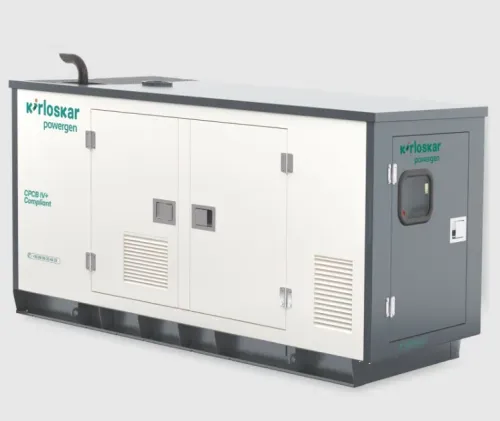
CPCB IV+ describes emissions compliance, not output size, sound level, automatic-transfer performance or motor-starting capability. For cpcb iv plus diesel generator sizes, demand these documents and identifiers:
- Exact engine model, alternator model, rated kVA, rated kW, and standby or prime designation
- CPCB type-approval or conformity documents and the manufacturer’s emissions label
- Guaranteed fuel consumption at stated load points, transient voltage and frequency response, and allowable ambient temperature
- Voltage, frequency, phase configuration, battery-starting arrangement and warranty exclusions
- Sound level with the measurement distance stated
Specify exhaust discharge above occupied areas, adequate ventilation, fuel storage, weather protection and protected cables. Portable equipment needs carbon-monoxide monitoring and clear outdoor placement; basement installations need engineered exhaust extraction, make-up air and CO detection with shutdown alarms. Confirm the ATS, earthing, fire separation and service intervals before ordering.
Make the final 25 kVA-versus-40 kVA decision from measured evidence
Choose a 25 kVA option when measured essential demand stays comfortably below about 20 kW at 0.8 power factor, motor starting is controlled, phase currents are balanced and expansion is limited.
Choose 40 kVA when the schedule approaches that limit, a compressor or pump starts direct-on-line, several loads transfer together, or planned equipment will use the spare capacity.
| Option | Technical fit | Commercial consequence |
|---|---|---|
| 25 kVA diesel generator for facility | Below about 20 kW essential demand; controlled starts and balanced phases | Lower purchase, fuel-system and space requirements |
| 40 kVA diesel generator for facility | Up to about 32 kW at 0.8 power factor, with greater load-step and expansion margin | Higher acquisition and operating capacity, justified by demand |
Do not select a 40kva or 25kva diesel generator for facilities in Bangalore from connected nameplates alone. A substantially oversized set running at very light load can lose fuel efficiency and breach the engine maker’s minimum-load guidance. More capacity is not automatically better.
Before comparing quotations, obtain:
- A site survey and one-line diagram
- Phase-by-phase kW, kVA and power-factor measurements
- A starting-load assessment covering direct-on-line motors and simultaneous transfers
- An ATS proposal showing switching and protection
- The exact CPCB IV+ engine configuration, not only a nominal kVA label
Metro Power Corporation is useful as a Bangalore-based authorized Kirloskar and KOEL supplier when it supplies these calculations and identifies the proposed engine and alternator configuration.
Related products
 | CPCB IV+ 25KVA TO 58.5KVA • Prime rating and Stand-by rating • State of the art Genset Controller • No replacement to displacement • Peace-of-mind Ownership • Best Fluid... View product → |
 | CPCB IV+ 25KVA TO 58.5KVA • Prime rating and Stand-by rating • State of the art Genset Controller • No replacement to displacement • Peace-of-mind Ownership • Best Fluid... View product → |
Frequently asked questions
How much usable power do 25 kVA and 40 kVA generators provide?
At a 0.8 power factor, a 25 kVA generator provides approximately 20 kW and a 40 kVA generator approximately 32 kW.
What must you test before choosing a 25 kVA or 40 kVA generator?
Test the largest motor starting current, load steps, voltage and frequency recovery, and the generator's operating margin.
Why must facility loads be balanced across three phases?
Phase balancing prevents one phase from reaching its current limit while the total generator load remains below the kVA rating.
When is a 40 kVA diesel generator the better choice for a Bangalore facility?
Choose 40 kVA when measured essential load, motor starting demand, future additions or Bangalore operating conditions leave inadequate margin on a 25 kVA set.
Keywords